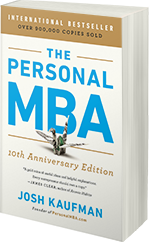
Master the Art of Business
A world-class business education in a single volume. Learn the universal principles behind every successful business, then use these ideas to make more money, get more done, and have more fun in your life and work.
The Personal MBA Manifesto: How To Learn Business Skills On Your Own Terms
"You wasted $150,000 on an education you coulda got for a buck fifty in late charges at the public library."
Will Hunting (played by Matt Damon), Good Will Hunting
MBA programs don't have a monopoly on advanced business knowledge: you can teach yourself everything you need to know to succeed in life and at work. The Personal MBA features the very best business books available, based on over ten years and thousands of hours of research. So skip business school and the $150,000 loan: you can get a world-class business education own your own at very low cost by reading the best business books.
This manifesto is the best way to learn what The Personal MBA is all about. To learn about the 99 Best Business Books officially recommended by The Personal MBA, check out the Personal MBA Recommended Reading List.
What Is The Personal MBA?
"Self-education is, I firmly believe, the only kind of education there is."
Isaac Asimov, renowned science fiction author
The Personal MBA is a project designed to help you educate yourself about advanced business concepts. This manifesto will show you how to substantially increase your knowledge of business on your own time and with little cost, all without setting foot inside a classroom.
The Personal MBA is more flexible than a traditional MBA program, doesn't involve going into massive debt, and won't interrupt your income stream for two years. Just pick up one of these business books, learn as much as you can, discuss what you learn with others, then go out into the real world and make great things happen.
If you're interested in educating yourself about business, The Personal MBA is the best place to start.
The 99 Best Business Books Available
"If I read a book that cost me $20 and I get one good idea, I've gotten one of the greatest bargains of all time."
Tom Peters, bestselling business author
The core of The Personal MBA is a list of the very best business books available, based on thousands of hours of reading, research, discussion, and evaluation.
Some books will give you tools: processes or actions you can apply immediately to improve your life and work. Others will give you ideas: help in envisioning what you and your business are capable of becoming. All of them will give you mental models: useful ways of thinking about the world that you can use to your advantage in a wide variety of situations.
By reading these books and applying what you learn to your daily life, you will progressively develop a greater understanding of business and increase your effectiveness in the working world. Each book in the list has been selected for a single purpose: to maximize your educational return on invested time.
For the Skeptics: Thoughts on Traditional MBA Programs
"Whatever be the qualifications of your tutors, your improvement must chiefly depend on yourselves. They cannot think or labor for you, they can only put you in the best way of thinking and laboring for yourselves. If therefore you get knowledge, you must acquire it by your own industry."
Joseph Priestly, Dedication of New College, London, 1794
The debate concerning the value of traditional MBA programs is long and involved, and this manifesto won't close the issue.
There's a growing body of research that suggests that MBA programs provide little value in relation to the direct and opportunity costs of completing the degree - for more details, read The End of Business Schools? Less Success Than Meets the Eye by the Academy of Management Learning and Education, which discusses this issue comprehensively.
For the sake of brevity, here's a short Q&A on the pros and cons of business school:
- Can a traditional MBA program help you? Yes. You'll meet a lot of great people and get acquainted with a few professors and corporate HR recruiters who can help you land a new job. In exchange, you will go deep into debt. If you decide to enroll in a full-time MBA program, you must also consider the opportunity cost of lost wages and long-term investable savings.
- Will a traditional MBA teach you anything you can't learn by yourself? Probably not. Classroom discussion can be beneficial, but there's nothing presented in a traditional MBA program that you can't learn by studying a few good books on the subject. Remember, the value of traditional MBA programs is not in the learning: the primary benefit is the connection to recruiters and other students.
- Is a traditional MBA worth my time and money? Unfortunately, there's no universal answer. If you're looking to go into advanced corporate accounting, finance, quantitative analysis, commercial real estate, Fortune 500 management consulting, venture capital, or investment banking, an MBA or MS in a business-related field may be expected or required. In those cases, caveat emptor: once you decide to attend a traditional business school, the only certainty is that you'll be up to your eyeballs in debt for a few decades.
To clarify, here's what I'm not saying about traditional MBA programs:
- I'm not saying "MBA programs are completely worthless and an abject waste of time and money." If you're aiming for a job at a Fortune 500 company in an industry in which you have no experience, you want to work for a company that directly rewards MBA graduates with higher pay or increased responsibility, or your employer is willing to pay the full cost of tuition, it may make sense to enroll in an MBA program. If you're an entrepreneur or middle manager at a company you like, your limited time and energy is probably best spent working on your business and learning on your own.
- I'm not saying "You won't learn anything useful in an MBA program." Like any other life experience, what you learn is primarily determined by how much energy and attention you choose to devote to the program. You can learn many useful things in an MBA program - you just won't learn anything you can't learn elsewhere more completely / quickly / inexpensively, and you'll waste a lot of time on things that simply aren't that important.
- I'm not saying "People who enroll in MBA programs are stupid." Prospective MBA students tend to be intelligent, driven, and ambitious, which are major assets. The irony is that the most promising MBA candidates are just as likely to succeed in business without an MBA as they are with the diploma. According to Dr. Jeffrey Pfeffer, professor of organizational behavior at Stanford GSB, "If you are good enough to get in, you obviously have enough talent to do well, regardless."
Whether or not you decide that a traditional MBA program is right for you, The Personal MBA is an effective, low-cost way to educate yourself about business.
Even if you're currently enrolled or have graduated from business school, you can benefit from reading these books - many current MBA candidates are active members of The Personal MBA community, and find a great deal of value in reading beyond what's required for their coursework.
Before we get to the reading list, however, allow me to set a few reasonable expectations.
The Personal MBA is not a credential
If you read these books, you won't have corporate recruiters beating down your door, and you won't have a pretty certificate to hang on your wall when you're done. You will, however, have an understanding of business that's comparable to (and in many ways, better than) completing a traditional business school curriculum, along with the pleasures of not having to mortgage your life for that understanding.
You do not need a certificate to be able to understand, use, and hold an intelligent conversation about advanced business topics. Employers do, however, respond well to portfolios.
If you build a portfolio of notes to capture what you learn through The Personal MBA, you'll have a tangible asset to prove your hard work and dedication during the interview process.
The Personal MBA is not a stand-alone venture
You can't learn about business solely from books (or sitting in a classroom); you have to be willing to go out and learn by doing. Whether you're working full-time for a company or building your own business, a great deal of your knowledge will develop as a direct result of your day-to-day work experiences, which provide the necessary context for understanding what you read.
Reading books is not enough; application of what you read is essential.
The Personal MBA is not a mindless replica of a traditional MBA program
The Personal MBA was created to expose you to a core set of advanced business concepts quickly and effectively. By design, it does not include everything you might come across in business school. If you're looking for a detailed analysis of the Black-Scholes option pricing model and its relationship to the volatility surfaces of certain financial derivatives, you're going to be very disappointed.
The Personal MBA focuses on knowledge that you'll find useful in the real world, not what an academic professor personally finds interesting.
The Personal MBA is not an impersonal curriculum
You'll find more material about learning who you are, what you're good at, and how to work more effectively with other people in The Personal MBA than you will in a standard business school curriculum.
There's a reason why these topics are included here: these "soft skills" are often more practical and important than theoretical knowledge, and will help you tremendously in your everyday life and work.
The Personal MBA is not an infallible educational revelation
It's perfectly okay if you disagree with one of the selections or think that a critical book has been overlooked. Feel free to make substitutions as you deem necessary.
If you're skeptical about the value of a title you haven't read yet, I encourage you to borrow the book from your local library and give it a try. If you're of the same opinion after reading a few chapters, put it down and read something else.
The Personal MBA is not easy
Working your way through this list will take time, energy, and persistence.
There is no substitute for hard work and dedication. I've structured this program to be as easy as possible to use, but it's up to you to put in the time and energy necessary to learn.
The Personal MBA Reading List Selection Criteria
There are thousands of great books about business on the market, but not every book is right for The Personal MBA. Here are the five criteria used to select the books featured by The Personal MBA:
- Valuable, Action-Oriented Content. Does the book contain a lot of useful, practical information about how business works, how you can add value, and why the material in the book is important? Is the book based on scientific research or direct personal experience? Does it contain tools, ideas, and concepts that can be put to use immediately in the real world?
- Acceptable Time Commitment. Is the book a good educational value for the amount of time invested? Can you get the key points of each book quickly?
- Self-Learning Friendly. Is this book designed to keep the reader's mind engaged? Does the author present the material effectively and make the learning process enjoyable?
- Reference Value. Will this book be a valuable resource to turn to when you need information on a specific topic? How does the book re-read? Is it a book worth keeping for many years?
- Comprehensive Set of Resources. For any business-related question, does at least one of these books provide useful guidance and insight?
Each recommendation is selected from a pool of hundreds of potential candidates, based on thousands of hours of research and evaluation as well as the suggestions and recommendations of a large and diverse group of volunteers.
I make every effort to avoid recommending “flavor of the month”-type books, books that happen to sell a large number of copies, and books that “everyone” thinks you should read. Business books, particularly in the management genre, can be very cargo-cultish, and I have several checks and balances that prevent me from recommending a book simply because it’s “hot.” The current list represents the result of my best efforts and research to date.
How to Use The Personal MBA
"A knowledge of the path cannot be substituted for putting one foot in front of the other."
M. C. Richards
Reading Strategy
Getting started with The Personal MBA is easy: find 2-3 business books that will help you develop your skills in the areas you're currently most interested in learning about, then start reading them. When you're done with those, pick a few more based on what you're most interested in learning.
I also highly recommend learning about effective non-fiction reading techniques to decrease the time it takes to complete each book. 10 Days to Faster Reading is a great place to start for best results.
For a quick, free primer on effective non-fiction reading techniques, check out How to Read a Book (PDF) by Paul N. Edwards.
Staying Motivated
Working through The Personal MBA with others is a very effective way to keep yourself motivated and on-track. By committing to read and discuss one book per week in a group setting, you're more likely to put forth the time and energy necessary to work your way through each book.
Creating a supportive environment will make it a lot easier for you to educate yourself, and you'll expand your professional network in the process.
Personalization
Your needs will be different than the needs of others, so personalization of your reading list is both necessary and valuable. It's best to read every book on the list, but not necessary.
For best results, focus on reading books that will help you develop the knowledge and skills you need most urgently to make progress toward your most important goals.
Get Started With The Personal MBA
"The difference between where you are today and where you'll be five years from now will be found in the quality of books you've read."
Jim Rohn, business teacher
Master the Art of Business
A world-class business education in a single volume. Learn the universal principles behind every successful business, then use these ideas to make more money, get more done, and have more fun in your life and work.
About Josh Kaufman
Josh Kaufman is an acclaimed business, learning, and skill acquisition expert. He is the author of two international bestsellers: The Personal MBA and The First 20 Hours. Josh's research and writing have helped millions of people worldwide learn the fundamentals of modern business.
More about Josh Kaufman →