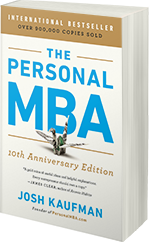
Master the Art of Business
A world-class business education in a single volume. Learn the universal principles behind every successful business, then use these ideas to make more money, get more done, and have more fun in your life and work.
From The Personal MBA's List of the 99 Best Business Books...

Review: 'Myths Of Innovation' by Scott Berkun
Innovation is a very hot topic in the business world. With the success of your business riding on having the "next big idea," how do you go about ensuring your thoughts are "innovative"?
In Myths of Innovation, Scott Berkun dispels 10 commonly held beliefs about innovation, revealing that there's nothing magical about discovering new ideas.
Using historical examples of innovations like the assembly line, QWERTY keyboard, and the airplane, Berkun shows that innovative ideas aren't created by divinely-inspired rogue geniuses... they're the result of the mundane preparation, research, experimentation, persistence, time, and luck of ordinary people who are open to new thoughts.
It's particularly difficult to innovate on demand, and Berkun is clear to point out that the best ideas don't always win. Even after having an idea, it's typically not apparent that's it's particularly innovative or good, and it's likely that your idea will face a great deal of resistance. By knowing what to expect in advance, you'll be less likely to give up or invest precious time and effort on adopting complex and unrealistic "innovation methodologies".
After reading Myths of Innovation, you'll be prepared to capture and experiment with promising ideas whenever, wherever, and however they show up.
The Personal MBA also recommends another book by Scott Berkun: Making Things Happen.
Buy 'Myths Of Innovation' by Scott Berkun
Books purchased through this website support The Personal MBA's ongoing research.
Master the Art of Business
A world-class business education in a single volume. Learn the universal principles behind every successful business, then use these ideas to make more money, get more done, and have more fun in your life and work.

About Josh Kaufman
Josh Kaufman is an acclaimed business, learning, and skill acquisition expert. He is the author of two international bestsellers: The Personal MBA and The First 20 Hours. Josh's research and writing have helped millions of people worldwide learn the fundamentals of modern business.
More about Josh Kaufman →