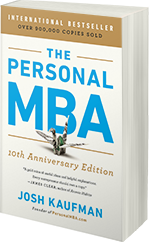
Master the Art of Business
A world-class business education in a single volume. Learn the universal principles behind every successful business, then use these ideas to make more money, get more done, and have more fun in your life and work.
The Personal MBA Recommended Reading List: The 99 Best Business Books
"You wasted $150,000 on an education you coulda got for a buck fifty in late charges at the public library."
Will Hunting (played by Matt Damon), Good Will Hunting
MBA programs don't have a monopoly on advanced business knowledge: you can teach yourself everything you need to know to succeed in life and at work. The Personal MBA features the very best business books available, based on over ten years and thousands of hours of research. So skip business school and the $150,000 loan: you can get a world-class business education own your own at very low cost by reading the best business books.
This page lists all Personal MBA recommended books and resources for easy printing, bookmarking, and reference. For more information about the Personal MBA and book selection criteria, read the manifesto.
Here are the 99 business books The Personal MBA officially recommends… click on the title of each book to read a detailed description of each book and why it’s important, or the buttons to the right for additional reviews.
Books purchased through this website support The Personal MBA's ongoing research.
Read This First For Best Results...
The Personal MBA: Master the Art of Business is a comprehensive overview of everything you’ll learn reading the books on this list. The book summarizes the most important ideas in business, psychology, and systems theory in a single volume.
I strongly recommend reading this book first - you’ll get much more from the books on this list if you learn the most important concepts first.
Business Creation
- Go It Alone – Bruce Judson
- The Lean Startup – Eric Ries
- Street Smarts – Norm Brodsky & Bo Burlingham
- Ready, Fire, Aim – Michael Masterson
- Escape from Cubicle Nation – Pamela Slim
- Bankable Business Plans – Edward Rogoff
Value-Creation & Testing
- Rework – Jason Fried & David Heinemeier Hansson
- The New Business Road Test – John Mullins
- How to Make Millions with Your Ideas – Dan Kennedy
Marketing
- All Marketers Are Liars – Seth Godin
- Permission Marketing – Seth Godin
- The 22 Immutable Laws of Marketing – Al Ries & Jack Trout
- Getting Everything You Can Out of All You’ve Got – Jay Abraham
Sales
- The Psychology of Selling – Brian Tracy
- Pitch Anything – Oren Klaff
- The Ultimate Sales Machine – Chet Holmes
- Value-Based Fees – Alan Weiss
- SPIN Selling – Neil Rackham
Value-Delivery
- Indispensable – Joe Calloway
- The Goal: A Process of Ongoing Improvement – Eliyahu Goldratt
- Lean Thinking – James Womack & Daniel Jones
Finance & Accounting
- Financial Intelligence for Entrepreneurs – Karen Berman & Joe Knight
- Simple Numbers, Straight Talk, Big Profits – Greg Crabtree
- The 1% Windfall – Rafi Mohammed
- Accounting Made Simple – Mike Piper
- How to Read a Financial Report – John A. Tracy
- Venture Deals – Brad Feld & Jason Mendelson
The Human Mind
- Thinking, Fast and Slow – Daniel Kahneman
- Brain Rules – John Medina
- Making Sense of Behavior – William T. Powers
- Driven – Paul Lawrence & Nitin Nohria
- Deep Survival – Laurence Gonzales
Productivity & Effectiveness
- Getting Things Done – David Allen
- The Power of Full Engagement – Jim Loehr &Tony Schwartz
- StrengthsFinder 2.0 – Tom Rath
- Bit Literacy – Mark Hurst
- 10 Days to Faster Reading – Abby Marks-Beale
Problem Solving
- The 80/20 Principle – Richard Koch
- Accidental Genius – Mark Levy
- Learning from the Future – Liam Fahey & Robert Randall
Behavioral Change
- The Power of Less – Leo Babauta
- The Path of Least Resistance – Robert Fritz
- Re-Create Your Life – Morty Lefkoe
- Self-Directed Behavior – David Watson & Roland Tharp
Decision-Making
- Sources of Power: How People Make Decisions – Gary Klein
- Smart Choices – John S. Hammond et al
- Ethics for the Real World – Ronald Howard & Clinton Korver
Communication
- On Writing Well – William Zinsser
- Presentation Zen – Garr Reynolds
- Made to Stick – Chip and Dan Heath
- The Copywriter’s Handbook – Robert Bly
- Show Me The Numbers – Stephen Few
Influence
- Influence: The Psychology of Persuasion – Robert B. Cialdini
- How to Win Friends and Influence People – Dale Carnegie
- Crucial Conversations – Kerry Patterson et al
- The 48 Laws of Power – Robert Greene
Negotiation
- Bargaining For Advantage – G. Richard Shell
- 3-D Negotiation – David Lax & James Sebenius
- The Partnership Charter – David Gage
Management
- First, Break All The Rules – Marcus Buckingham & Curt Coffman
- 12: The Elements of Great Managing – Rodd Wagner & James Harter
- Growing Great Employees – Erika Andersen
- The Essential Drucker – Peter Drucker
- The Halo Effect – Phil Rosenzweig
Leadership
- Tribes – Seth Godin
- Total Leadership – Stewart Friedman
- What Got You Here Won’t Get You There – Marshall Goldsmith
- The New Leader’s 100-Day Action Plan – George Bradt et al
Project Management
- Making Things Happen – Scott Berkun
- Results Without Authority – Tom Kendrick
Systems
- Thinking in Systems – Donella Meadows
- Work the System – Sam Carpenter
Analysis
- Thinking Statistically – Uri Bram
- Turning Numbers Into Knowledge – Jonathan Koomey
- How to Lie with Statistics – Darrell Huff
- Marketing Metrics – Paul Farris et al
- The Economist Numbers Guide – Richard Stuteley
Corporate Skills
- The Unwritten Laws of Business – W.J. King
- The Effective Executive – Peter Drucker
- The Simplicity Survival Handbook – Bill Jensen
- Hire With Your Head – Lou Adler
Corporate Strategy
- Purpose – Nikos Mourkogiannis
- Competitive Strategy – Michael Porter
- Blue Ocean Strategy – W. Chan Kim & Renée Mauborgne
- Seeing What’s Next – Clayton M. Christensen et al
Creativity & Innovation
- The Creative Habit – Twyla Tharp
- Myths of Innovation – Scott Berkun
- Innovation and Entrepreneurship – Peter Drucker
Design
- The Design of Everyday Things – Donald Norman
- Universal Principles of Design – William Lidwell et al
Consulting
- Getting Started in Consulting – Alan Weiss
- Secrets of Consulting – Gerald M. Weinberg
Personal Finance
- Your Money or Your Life – Joel Dominguez & Vicki Robin
- The Millionaire Next Door – Thomas Stanley & William Danko
- I Will Teach You To Be Rich – Ramit Sethi
- Fail-Safe Investing – Harry Browne
Personal Growth
- Lead the Field – Earl Nightingale
- The Art of Exceptional Living – Jim Rohn
- A Guide to the Good Life – William Braxton Irvine
Some readers are curious about books that were featured on past editions of The Personal MBA recommended reading list. To view past recommendations, check out the Deprecated page.
Master the Art of Business
A world-class business education in a single volume. Learn the universal principles behind every successful business, then use these ideas to make more money, get more done, and have more fun in your life and work.

About Josh Kaufman
Josh Kaufman is an acclaimed business, learning, and skill acquisition expert. He is the author of two international bestsellers: The Personal MBA and The First 20 Hours. Josh's research and writing have helped millions of people worldwide learn the fundamentals of modern business.
More about Josh Kaufman →